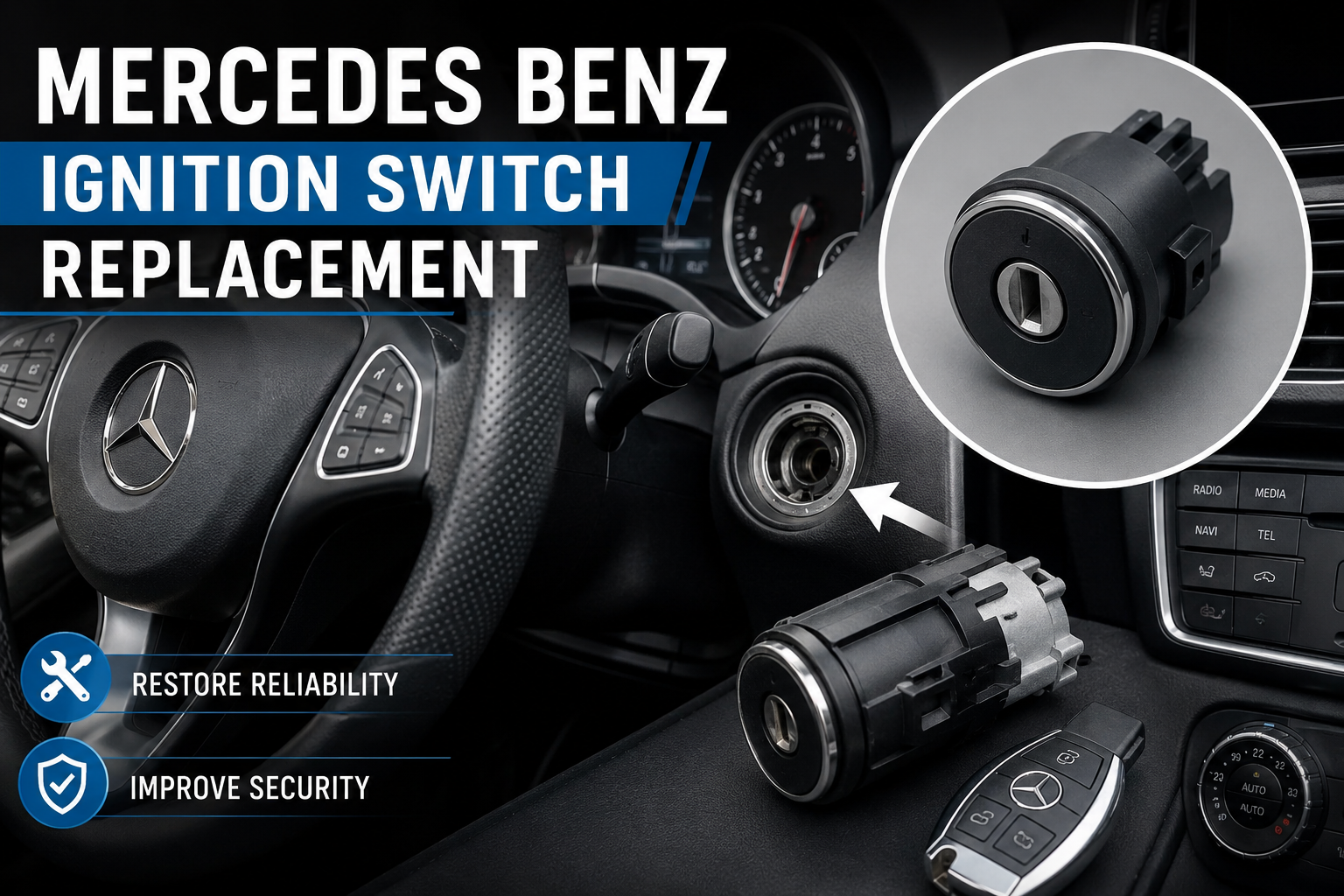
Mercedes Benz Ignition Switch Replacement – What Every Owner Should Know
There’s a particular kind of dread that sets in when you slide your key into the ignition of your Mercedes-Benz and nothing happens. No reassuring click, no dashboard lights flickering to life — just silence. For a car engineered to near-perfection, that silence speaks volumes. It usually points to one culprit: the ignition switch.
Whether you drive an E-Class, a C-Class, or an older S-Class with decades of loyalty behind it, ignition problems are more common than most Mercedes owners expect. This guide walks you through everything you need to know — from spotting the early warning signs to understanding what a proper Mercedes Benz ignition switch replacement actually involves.
Why the Ignition Switch Matters More Than You Think
The ignition switch is not just a mechanical on/off button. In a modern Mercedes, it’s the gateway between you and the car’s entire electrical ecosystem. When you turn the key or press the start button, the ignition switch signals the engine control unit, the fuel pump, the starter motor, and a cascade of sensors and modules to wake up and get to work.
When that switch begins to fail — even partially — the consequences ripple outward. You might notice intermittent starting, electrical accessories cutting out mid-drive, or a dashboard that behaves unpredictably. Ignoring these signs doesn’t make them go away. It usually makes them worse, and more expensive.
Recognising Mercedes Ignition Switch Problems Early
Most mercedes ignition switch problems don’t appear overnight. They build gradually, and the car often tries to warn you before leaving you stranded in a car park at 7 in the morning.
The Car Won’t Start — Or Starts Inconsistently
This is the most obvious symptom, but it’s worth paying attention to the pattern. If your Mercedes starts fine on cold mornings but struggles after it’s been sitting in the heat, or if it only starts on the second or third attempt, the ignition switch’s internal contacts may be wearing out. Heat causes them to expand and lose continuity; a problem that worsens over time.
Electrical Accessories Cutting Out While Driving
If your radio suddenly goes quiet, your air conditioning drops off, or your power windows stop responding — especially while the car is running — that’s a classic sign of a failing ignition switch. The switch controls power delivery to accessory circuits, and worn contacts disrupt that flow unpredictably.
Key Gets Stuck or Feels Stiff
A key that’s hard to insert, difficult to turn, or won’t come out cleanly after you’ve parked points to mechanical wear inside the ignition cylinder itself. Sometimes this is a lubrication issue. Other times, it signals the ignition cylinder is on its way out and needs replacement alongside the switch.
Mercedes Computer Diagnostics — The First Step Before Any Repair
Here’s where a lot of DIY approaches go wrong: replacing parts without knowing exactly what’s failed. Before any technician picks up a tool, the right move is mercedes computer diagnostics.
Mercedes vehicles store fault codes in multiple control modules — the engine ECU, the EIS (Electronic Ignition Switch) module, the SAM (Signal Acquisition Module), and others. A standard OBD-II reader won’t access most of these. You need a Mercedes-specific diagnostic system — something like XENTRY/DAS or an equivalent professional tool — to pull accurate fault codes and live data from the relevant modules.
This matters because ignition-related symptoms can also stem from a failing EIS module, a worn steering column lock, a dead key fob battery, or issues with the immobilizer system. Computer diagnostics separate the actual cause from the symptoms, which saves you from replacing an ignition switch only to discover the real problem was something else entirely.
What a Diagnostic Session Reveals
A proper diagnostic session will identify fault codes related to no-start conditions, communication failures between the EIS and ECU, immobilizer faults, and voltage irregularities in the ignition circuit. Armed with this data, a technician can recommend the right repair with confidence rather than guesswork.
Mercedes Ignition Repair: Understanding Your Options
Once diagnostics confirm the ignition switch is at fault, you have a few paths forward. Understanding the difference between them helps you make an informed decision rather than simply accepting whatever a workshop quotes you.
Ignition Switch Replacement
This is the most common resolution for electrical ignition faults. The mercedes benz ignition switch repair or full replacement involves accessing the switch assembly — typically located behind the steering column shroud — disconnecting the electrical connector, and installing a new unit. On newer Mercedes models, this may require coding the new switch to the car’s EIS module, which is another reason professional diagnostics and programming tools are essential.
Ignition Cylinder Replacement
If the mechanical side of the ignition is at fault — stiff key, worn lock cylinder — the cylinder itself may need replacement separately from the switch. In some models, these are replaced as a combined assembly. A locksmith or automotive specialist with Mercedes experience can advise on whether a cylinder replacement also requires key re-coding.
EIS Module Repair or Replacement
For more complex mercedes ignition repair scenarios, particularly on W211 E-Class and W220 S-Class models, the Electronic Ignition Switch module itself can fail. EIS replacement is a more involved job — it typically requires the car to be towed to a specialist, as the module needs to be matched and programmed to the vehicle’s existing keys and immobilizer data.
Mercedes Benz Ignition Coil Replacement — A Related Issue Worth Knowing
While diagnosing ignition problems, technicians occasionally discover that the root cause isn’t the switch at all — it’s the ignition coils. Ignition coils are responsible for converting the battery’s low voltage into the high voltage needed to create a spark in each cylinder.
When coils fail on a Mercedes, the symptoms can look similar to switch problems: misfires, rough idle, hesitation during acceleration, and in some cases, a no-start condition. Mercedes benz ignition coil replacement is a more straightforward job than EIS module work, but it still requires correct diagnostic confirmation first. Replacing coils on suspicion alone — without confirming which cylinder is misfiring — is an unnecessary expense.
On most Mercedes petrol engines, coils are replaced individually per cylinder. Some workshops replace all coils at once if the car has high mileage, reasoning that if one has failed, the others are likely close behind. Whether that approach is right for your car depends on mileage, service history, and your mechanic’s honest assessment.
The Right Way to Approach Mercedes Ignition Switch Repair
Let’s be honest: mercedes ignition switch repair is not a typical weekend DIY project for most people. It’s not impossible, but it requires specific tools, knowledge of Mercedes electrical systems, and in many cases, access to dealer-level programming software to complete the job properly.
Here’s what a responsible repair process looks like:
Step one is a thorough diagnostic session using Mercedes-compatible software. This confirms the fault before a single part is ordered.
Step two is sourcing the correct replacement part. Mercedes ignition components vary significantly between model years and engine variants. An OEM part or a high-quality aftermarket equivalent — not a budget substitute from an unverified supplier — is the right call for a vehicle of this calibre.
Step three is the physical replacement, performed by someone who knows the quirks of Mercedes steering column assemblies and electrical connectors.
Step four is post-installation programming, where required. On models with EIS integration, the new switch must be coded to communicate correctly with the car’s immobilizer and ECU. Skip this step and the car simply won’t start.
Step five is a final diagnostic scan and test drive to confirm everything is functioning as it should — no residual fault codes, clean starts, and all electrical accessories responding correctly.
How Long Should a Replacement Ignition Switch Last?
A properly installed, genuine-quality ignition switch on a well-maintained Mercedes should last well over 100,000 miles. Premature failure usually comes down to one of three things: a substandard replacement part, an installation error that puts mechanical stress on the new switch, or an underlying electrical issue — like a voltage spike or a short circuit — that wasn’t identified and resolved before the replacement was made.
This is why skipping the diagnostic step is such a costly mistake. If there’s an underlying fault drawing excess current through the ignition circuit, a new switch will fail just as the old one did — just more quickly and expensively.
Final Thoughts
A Mercedes-Benz earns its reputation through precision engineering — but that precision also means its ignition system is more complex than what you’d find in most other vehicles. When something goes wrong, the answer isn’t to guess and replace parts at random. It’s to start with proper mercedes computer diagnostics, understand what you’re actually dealing with, and then proceed with a repair that’s done correctly the first time.
Whether you’re facing a straightforward mercedes benz ignition switch replacement or something more involved like EIS module work or ignition coil replacement, the process is the same: diagnose first, repair with quality parts, and programme where required. That approach keeps your Mercedes doing what it was built to do — starting reliably, every single time.