How Mercedes Ignition Switch Problems Affect Miami Drivers and What to Do Next
The ignition switch on a Mercedes-Benz is not a simple mechanical part. It sits at the intersection of the vehicle’s physical security system and its electronic architecture, passing signals that authorize everything from the starter motor to the engine control unit. Over time, several factors push it toward failure.
Heat is the most persistent culprit in Miami’s climate. The steering column area experiences significant thermal cycling — hot days, cold air-conditioning, hot days again — and the internal contacts of the switch degrade faster than in cooler environments. Add years of mechanical wear from the key being inserted and turned thousands of times, and the internal components simply wear out. In other cases, electrical faults elsewhere in the vehicle send irregular voltage spikes through the ignition circuit, accelerating the switch’s deterioration from the inside.
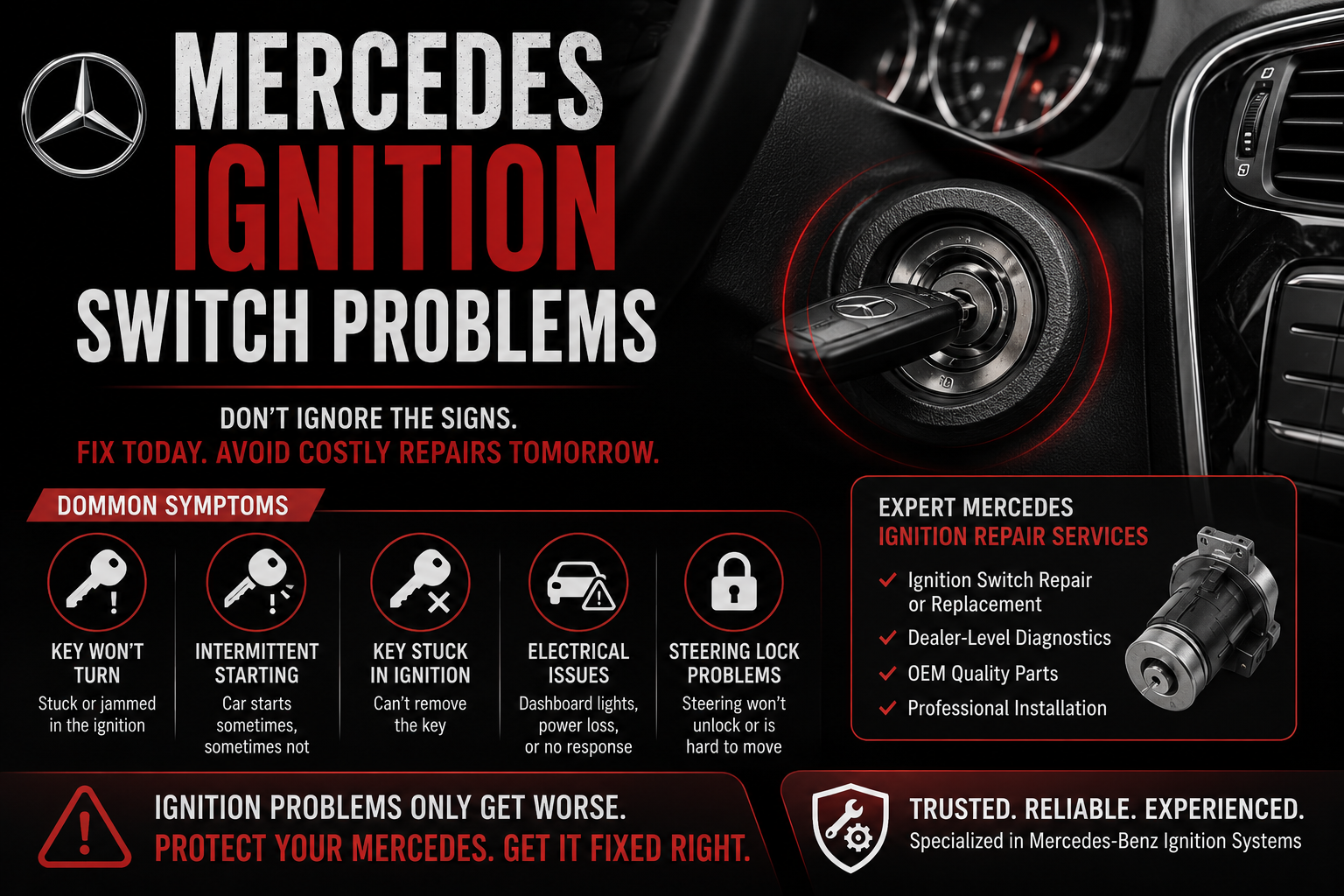
The Warning Signs Most Drivers Miss Early On
Mercedes ignition switch problems rarely arrive without warning. The trouble is that early symptoms are easy to dismiss or attribute to something else — a bad day, a tired battery, a fluke. Recognizing the pattern early is what separates a minor repair bill from a major one.
- The key requires extra force to turn, or feels stiff in positions it was previously smooth
- The car starts on some attempts but not others, with no clear pattern
- Dashboard warning lights flicker or illuminate briefly at startup then disappear
- Electrical accessories — windows, climate control, radio — cut out momentarily when starting
- A “key not recognized” message appears despite using the correct, programmed key
- The steering column feels hot or emits a faint burning smell after driving
Any one of these in isolation might be noise. Two or more together, especially recurring over days or weeks, is the ignition switch telling you it’s time to pay attention.
Mercedes Ignition Switch Repair — When It’s Still Fixable
Not every ignition problem requires pulling the whole assembly and starting from scratch. In a meaningful number of cases, Mercedes ignition switch repair is the right answer — and it’s considerably more affordable than full replacement. A skilled technician can often clean and refurbish corroded contacts, address worn mechanical detents within the switch housing, and resolve intermittent connection faults without touching the broader ignition system.
The practical question is whether the damage is recoverable. If the switch is intermittently faulty — working most of the time but occasionally misbehaving — repair is usually viable and worth attempting first. If the unit has failed outright, if the contacts are burned through, or if the housing is physically cracked, repair becomes a short-term patch on a component that will fail again soon. That’s when replacement is the honest recommendation, and any technician worth trusting will tell you so upfront.
Honest advice: If a shop recommends full replacement without attempting diagnosis first, get a second opinion. A proper evaluation takes twenty minutes and tells you exactly what you’re dealing with. Skipping it almost always costs more in the long run.
Mercedes Sprinter Ignition Switch Replacement: A Different Animal
Commercial operators running Mercedes Sprinter vans across Miami — delivery services, shuttle companies, tradespeople — face a specific ignition challenge that passenger car owners don’t. The Sprinter’s ignition system is built for commercial duty, but that also means it takes more punishment: more daily start cycles, more weight on the key ring from commercial keychains, more heat from extended idling in the Miami sun.
Mercedes Sprinter ignition switch replacement is a more involved job than the equivalent work on a C-Class or E-Class. The Sprinter’s column design and the way the switch integrates with its immobilizer require model-specific tooling and familiarity with the commercial platform. A shop that primarily handles passenger Mercedes may not carry the right components or have the software to properly initialize the replacement unit. For Sprinter operators, finding a specialist who works regularly on the commercial platform is worth the extra step.
Downtime is money in a commercial fleet, which makes getting it right the first time even more critical. A Sprinter that can’t start on a delivery morning doesn’t just inconvenience a driver — it disrupts an entire schedule. Proactive replacement when early symptoms appear, rather than waiting for complete failure, is the approach that keeps commercial operators moving.
When the Problem Goes Deeper: Electronic Ignition and Module Repairs
Some Mercedes ignition problems sit above the physical switch entirely — in the electronic layer that governs how the car interprets and responds to key input. This is where things get genuinely technical, and where the difference between a Mercedes specialist and a general mechanic becomes most apparent.
Mercedes Electronic Ignition Switch Repair
The Electronic Ignition Switch — the EIS unit — is the brain of the key authentication process on modern Mercedes vehicles. It reads the encrypted data from your key’s transponder chip, cross-references it with the immobilizer, and either authorizes or refuses engine start. Mercedes electronic ignition switch repair addresses faults within this unit: communication errors, failed internal components, or software corruption that causes the car to behave as though the key doesn’t exist even when it’s perfectly programmed.
EIS faults can mimic other problems. A car that won’t start despite a good battery, a working starter, and a properly coded key is often pointing directly at an EIS fault. The challenge is that confirming this — and distinguishing it from other possible causes — requires diagnostic equipment that reads Mercedes-specific protocols, not the generic OBD readers found at chain auto parts stores.
Mercedes Ignition Module Repair
Closely related but distinct, Mercedes ignition module repair addresses the control module that manages ignition timing and signal distribution across the system. When this module develops faults, the car may start erratically, misfire at startup, or throw fault codes that seem unrelated to the ignition until you trace the signal path back to the source. Module repairs require reading stored fault data, identifying whether the issue is hardware or software, and either reflashing the existing unit or replacing it — always followed by proper initialization and testing.
Critical note: Replacing an EIS or ignition module without properly coding it to the vehicle’s existing key data will leave you with a car that won’t start at all. This is one of the most common and costly mistakes made by shops without Mercedes-specific programming capability. Always confirm your technician has the right tools before authorizing this work.
Mercedes Computers Diagnostics in Brickell — Why Location and Expertise Both Matter
For Mercedes owners in and around Brickell, access to proper Mercedes computers diagnostics in Brickell is the step that makes everything else make sense. A thorough electronic diagnostic — using Mercedes-compatible systems like XENTRY or equivalent specialist software — reads every fault code stored across the vehicle’s network, maps them chronologically, and identifies whether you’re dealing with a switch fault, an EIS fault, a module issue, or something in the wiring between them.
This matters because ignition symptoms overlap. A worn switch, a failing EIS unit, and a bad ignition module can all present similarly to a driver but require completely different repairs. Treating the wrong component not only wastes money — it leaves the actual fault in place, and you’ll be back in the same situation within weeks. A proper diagnostic tells the technician exactly where in the signal chain the problem lives before a single part is ordered.
What a Proper Mercedes Diagnostic Covers
Beyond reading fault codes, a thorough diagnostic for ignition-related concerns will test live data from the EIS module during key insertion, measure voltage at the switch contacts under load, check the immobilizer communication loop, and verify that all relevant control units are communicating correctly with each other. It’s a systems-level view, not just a point-in-time snapshot of warning lights.
Mercedes Ignition Repair After Diagnostics: The Right Sequence
The correct workflow for any significant Mercedes ignition repair always starts with diagnostics, then moves to targeted repair or replacement of confirmed faulty components, followed by post-repair verification testing. Skipping the first step is what leads to stories of drivers who replaced three parts before finding the actual problem. It costs more, takes longer, and creates unnecessary frustration that a twenty-minute diagnostic session would have avoided entirely.
For Miami and Brickell drivers specifically — where temperatures accelerate wear and where many residents rely on their vehicles without a secondary option — getting this sequence right isn’t just good practice. It’s what protects you from being stranded on a schedule that doesn’t have room for it.
The Bottom Line: Don’t Wait, and Don’t Guess
Mercedes ignition switch problems are manageable when caught early and diagnosed correctly. They become expensive and disruptive when ignored or misdiagnosed. The pattern is consistent: early symptoms appear, get dismissed, worsen, and eventually result in a car that won’t start at the worst possible moment.
Whether you’re driving a C-Class in Brickell, a Sprinter van across Dade County, or an older E-Class that’s been running beautifully for a decade, the ignition system deserves the same attention you’d give any other critical component. A specialist who knows Mercedes architecture, carries the right diagnostic tools, and will give you a straight answer about what the car actually needs — that’s the standard to hold any service provider to.
Mercedes Keys Miami offers mobile ignition diagnostics, repair, and replacement across Miami — and for drivers in the area, our Mercedes computers diagnostics in Brickell service brings Mercedes-specific tooling directly to you, with the expertise to get it right the first time.